Back to projects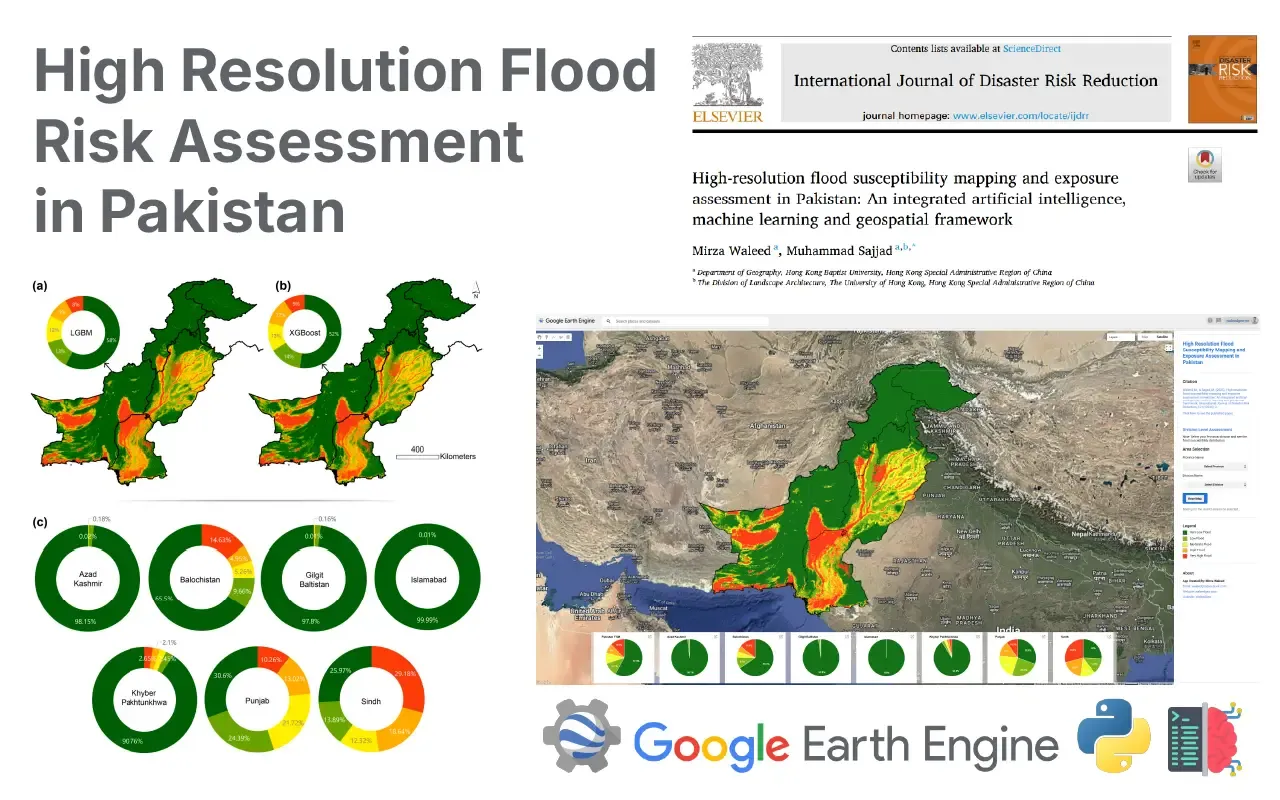
March 2024
Flood Risk Analytics for Pakistan
High-resolution (30m) flood susceptibility mapping and population exposure analysis for Pakistan, integrating ensemble machine learning with geospatial big data to support national disaster risk reduction.
GEEGeoAIMLPythonRS & GIS
Connecting flood susceptibility with exposure in Pakistan
FSM-PK brings together national 30-metre flood susceptibility mapping and geospatial exposure analysis. It helps users examine where flood-prone conditions coincide with people and economic activity, supporting the selection of areas for more detailed investigation.
The project links an Earth Engine application, the research implementation, and a study in the International Journal of Disaster Risk Reduction. The map describes susceptibility: a modeled spatial tendency toward flooding under the study’s data and assumptions. The exposure analysis adds information about what lies in those areas. Neither layer alone is a complete estimate of risk or expected damage.
Data and modeling workflow
Historical flood information from 2010, 2014, and 2022 supplies the flood inventory. The study constructs 20,000 stratified random sample points, divided equally between 10,000 flooded and 10,000 non-flooded locations. Environmental predictors describe terrain, drainage, rainfall, vegetation, and proximity to features such as roads.
Google Earth Engine supports geospatial data preparation, alongside local processing and machine-learning analysis. The study compares LightGBM and XGBoost to model the relationship between the inventory and the conditioning factors. The mapped output translates those relationships into relative susceptibility across Pakistan.
This combination makes national patterns easier to inspect within a common framework. It does not mean that all input datasets contain independently measured information at 30-metre detail, or that the workflow directly simulates floodwater movement.
Adding the human context
The exposure component combines susceptibility with WorldPop population data and nighttime lights. Population layers help locate people within the mapped classes; nighttime lights provide a proxy for economic activity. The resulting spatial comparisons highlight concentrations of exposure, including areas of Sindh and Punjab.
These overlays depend on their own observation periods and assumptions. A population surface is an estimate rather than a household census at each pixel. Nighttime lights can underrepresent rural activity and should not be treated as a direct valuation of buildings, livelihoods, or economic losses.
Model explanation methods, including SHAP, help examine which predictors influence the fitted models. They describe attribution within the model; they do not establish that a predictor causes flooding or that changing it would produce a particular real-world outcome.
Evaluation and interpretation
The study uses stratified ten-fold cross-validation to evaluate model performance. This tests the models within the sampled dataset; it is not equivalent to a spatially independent test in an entirely unseen region or a forecast evaluation for a future flood.
Historical inventories can miss events or represent different mapping conditions. Terrain, drainage, and rainfall information also have scale and timing limits. Before applying the results locally, check recent land-use change, flood defenses, drainage works, and the quality of the underlying observations.
When reporting exposure totals, state the exact susceptibility classes and population year included and calculate the corresponding totals from the source layers. This makes district and province comparisons interpretable and helps distinguish changes in the mapped hazard-related pattern from changes in the exposure data.
Using FSM-PK in practice
- Explore the national pattern in the Earth Engine application, then identify the province, district, or catchment relevant to your question.
- Inspect the implementation in the source repository. Check the inventory, predictor preparation, and classification assumptions before adapting the workflow.
- Define your exposure question. Record the population layer’s year, analysis boundary, included susceptibility classes, and treatment of missing data. Distinguish a count of exposed people from an estimate of vulnerability or losses.
- Read the evidence in the paper explanation, full paper, and published study.
Appropriate uses include national and regional screening, comparing exposure patterns, and prioritizing locations for field assessment or finer-scale modeling. Event forecasting, flood depth estimation, engineering design, and parcel-level decisions require additional information and methods.
Case study updated .
Related Projects
Interested in collaborating or have questions about this project?
Get in Touch