Back to projects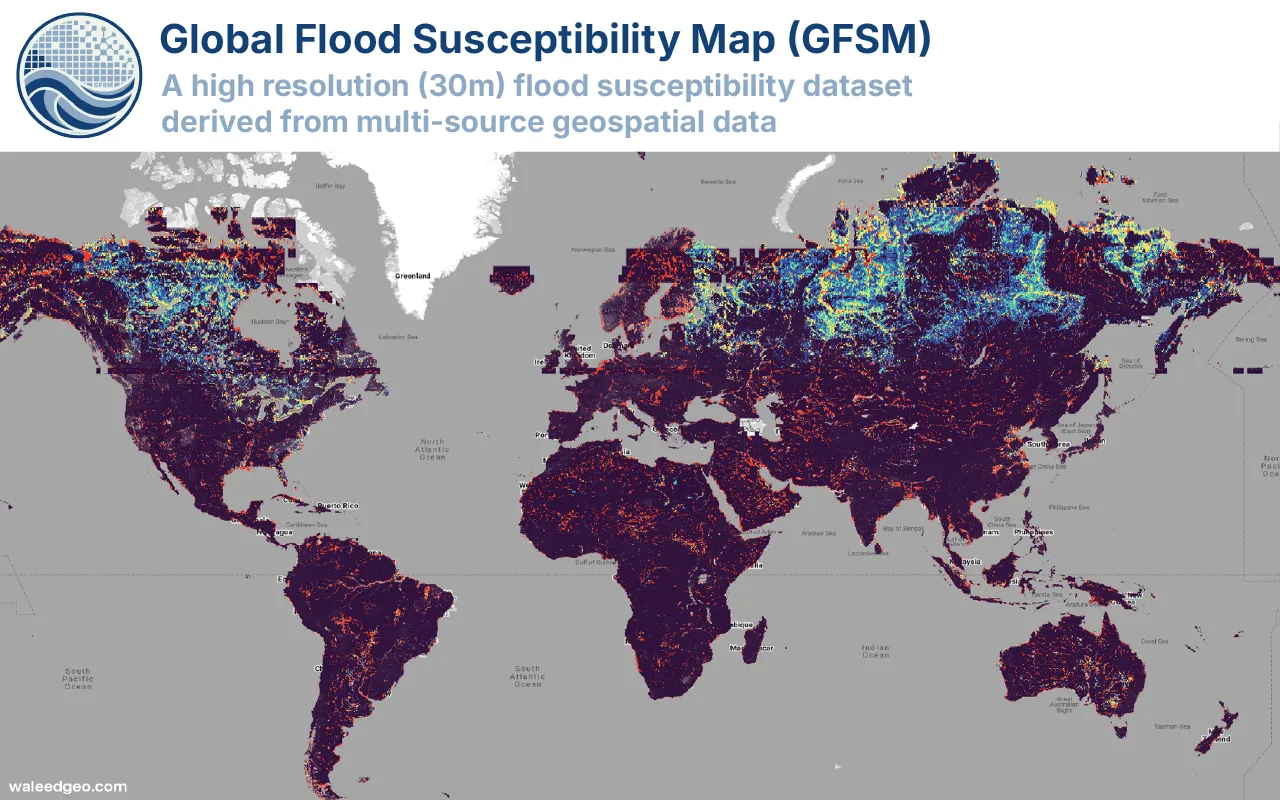
September 2026
Global Flood Susceptibility Map (GFSM v1)
An open, globally harmonized 30-meter flood susceptibility dataset built from multi-source Earth observation data and approximately 30.45 million training samples.
GeoAIMLGEEHPCRS & GIS
A consistent starting point for flood screening
GFSM v1 brings a common flood susceptibility framework to a global 30-metre grid. It is designed for researchers and practitioners who need to compare places, identify areas for closer investigation, or combine a flood-related layer with population and asset data. The project connects a downloadable dataset, an interactive map, and the implementation behind the accompanying Scientific Data study.
The central distinction is between susceptibility and an individual flood event. GFSM describes relative flood propensity under the study’s inputs and reference labels. Its 30-metre grid helps locate patterns in greater detail, but does not establish that every pixel has independently observed flood evidence at that resolution.
From Earth observation to a global dataset
The workflow combines nine conditioning factors describing terrain, hydrology, vegetation, rainfall, and human influence. Google Earth Engine supports preparation of the Earth observation inputs; the modeling workflow uses XGBoost and high-performance computing to extend the analysis across countries and climate settings.
The study reports approximately 30.45 million samples from 17,069 curated tiles, covering 192 country–climate units. The reference labels derive from the Aqueduct modeled five-year riverine and coastal flood hazard baseline. These labels are coarser than the output grid, which matters when interpreting apparent local detail.
The resulting product offers a harmonized screening layer rather than requiring each user to build a separate national model. The code and paper document how the reference data, predictors, training, and mapping fit together.
What the dataset contains
The release provides GeoTIFF tiles in EPSG:3395, with coverage extending approximately from 80°N to 60°S. Five equal-interval susceptibility classes encode the modeled pattern:
| Value | Meaning |
|---|---|
| 0 | NoData; exclude from class totals |
| 1 | Very low susceptibility |
| 2 | Low susceptibility |
| 3 | Moderate susceptibility |
| 4 | High susceptibility |
| 5 | Very high susceptibility |
The classes are relative categories, not annual exceedance probabilities. For area summaries, use an appropriate equal-area calculation rather than treating the projected pixel dimensions as globally equal ground areas. Preserve NoData when clipping or combining the tiles with other layers.
Validation and what it establishes
The paper reports median ROC-AUC of approximately 0.95 and median F1 of approximately 0.89 in its internal evaluation against the reference labels. These results describe agreement within that evaluation design. They do not establish event-specific flood depth, the performance of a local defense system, or independent accuracy for every 30-metre cell.
Coarse reference labels, uneven source information, and differences in local drainage and flood defenses constrain interpretation. The release does not supply a formal per-pixel uncertainty layer. Local evidence remains essential before using the map to inform engineering, insurance, or site-level decisions.
Start using GFSM
- Explore the pattern: use the interactive dashboard to locate your region and identify the scale of the mapped features.
- Get the research data: follow the versioned Zenodo record, inspect its file inventory and spatial index, and retain the release information with your analysis.
- Prepare an exposure analysis: align boundaries and exposure data, handle NoData explicitly, and choose resampling methods suited to categorical classes. Start with a class-area summary for your region before introducing population or asset layers.
- Check the scientific assumptions: consult the paper explanation, full paper, and source repository before interpreting local results.
Useful applications include regional screening, comparative exposure studies, and identifying locations that merit better local data. An exposure overlay should report its population or asset-data date and class threshold; it should not be presented as predicted losses or as a complete measure of flood risk.
Case study updated .
Related Projects
Interested in collaborating or have questions about this project?
Get in Touch