Land Cover & Carbon Storage Change Assessment
Nationwide study quantifying the impact of urbanization-driven land cover changes on terrestrial carbon storage in Pakistan from 1990 to 2020, using remote sensing and machine learning.
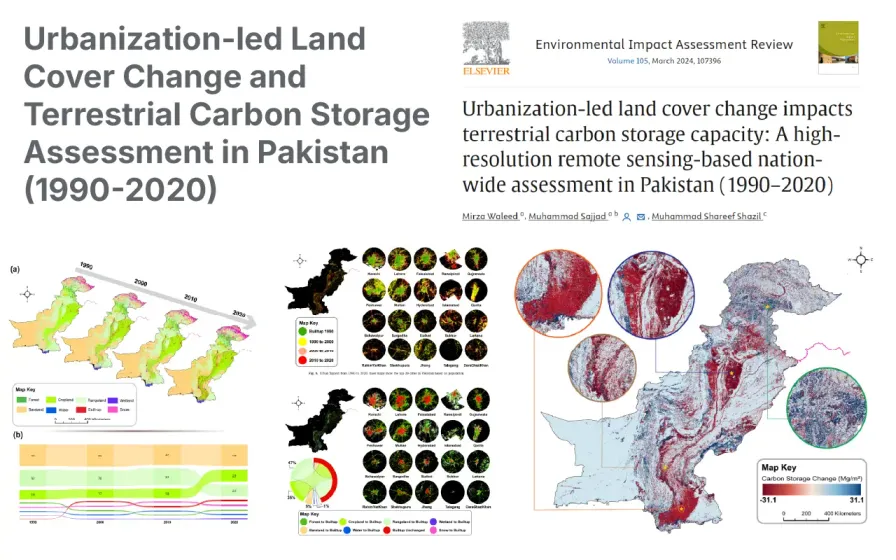
Objective. Rapid urbanization in Pakistan has driven substantial land cover transformation, but its cumulative effect on terrestrial carbon storage capacity had not been systematically quantified at the national scale.
Approach. Classified three decades (1990–2020) of satellite imagery using machine learning to map land use and land cover change across Pakistan. Integrated the classification outputs with the InVEST carbon storage model to estimate changes in above-ground, below-ground, soil, and dead organic carbon pools associated with each land cover transition.
Impact. Results demonstrate measurable declines in national carbon storage capacity linked to the expansion of built-up areas at the expense of agricultural and vegetated land. Published in Environmental Impact Assessment Review. The methodology provides a replicable framework applicable to other rapidly urbanizing regions.
Related Projects
Interested in collaborating or have questions about this project?
Get in Touch